Interview with PLASTICPRODUCT
“What we explore is not existing concepts, but new perspectives — alternative ways of seeing.”
Mincheol Seo
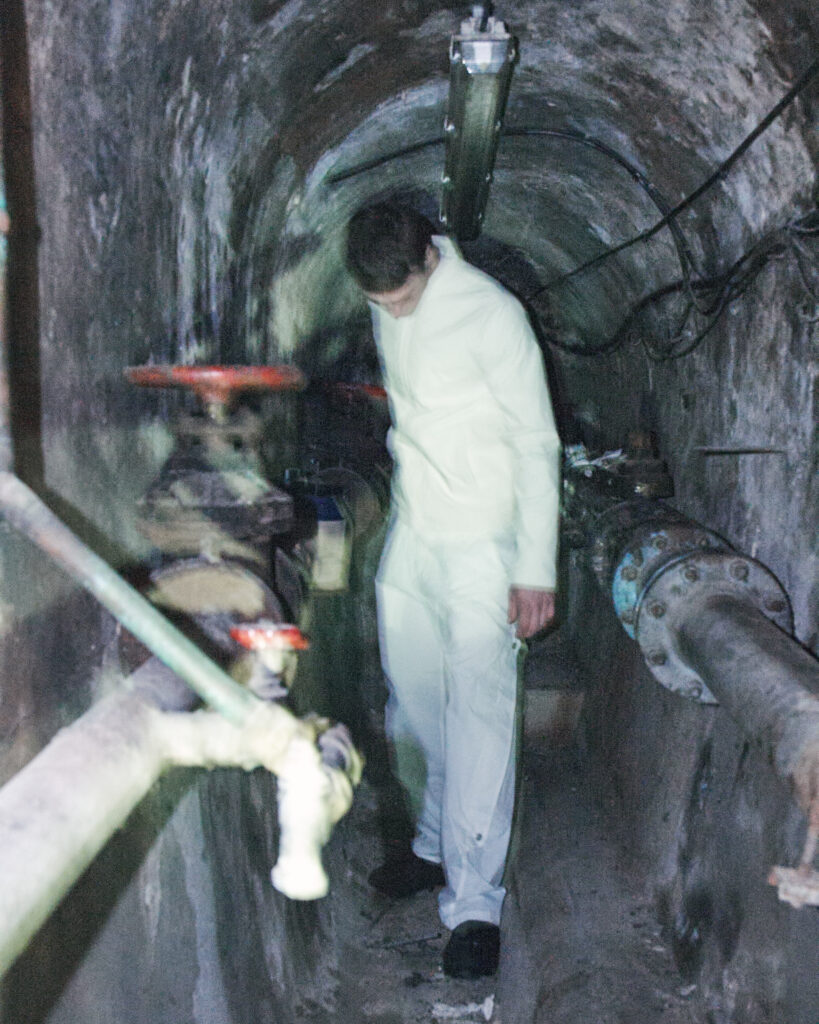
PLASTICPRODUCT MPa ——Fashion as Habitable Space
PLASTICPRODUCT is a Seoul-based fashion brand founded in 2020. Its name reflects the brand’s distinctive attitude: reconsidering familiar materials and objects — even something as ordinary as plastic — through an alternative perspective.
As a fashion label, PLASTICPRODUCT carries an unusual aura. This comes not only from the conceptual approach embedded in its products, but also from how they communicate through a combination of visual language, objects, and spatial experiences.
Its extended project Mass-Produced Articles (MPa) is based on a shift in perspective: changing the purpose of familiar things by viewing them differently. This idea, which resonates with the philosophy behind the brand name itself, provides a consistent foundation throughout its diverse practices.
From ZINE to spatial installations, PLASTICPRODUCT explores multiple forms of communication. Although the mediums differ, the underlying concept remains loyal. Through a unique cross-disciplinary approach, the brand communicates its ideas through perception and experience.
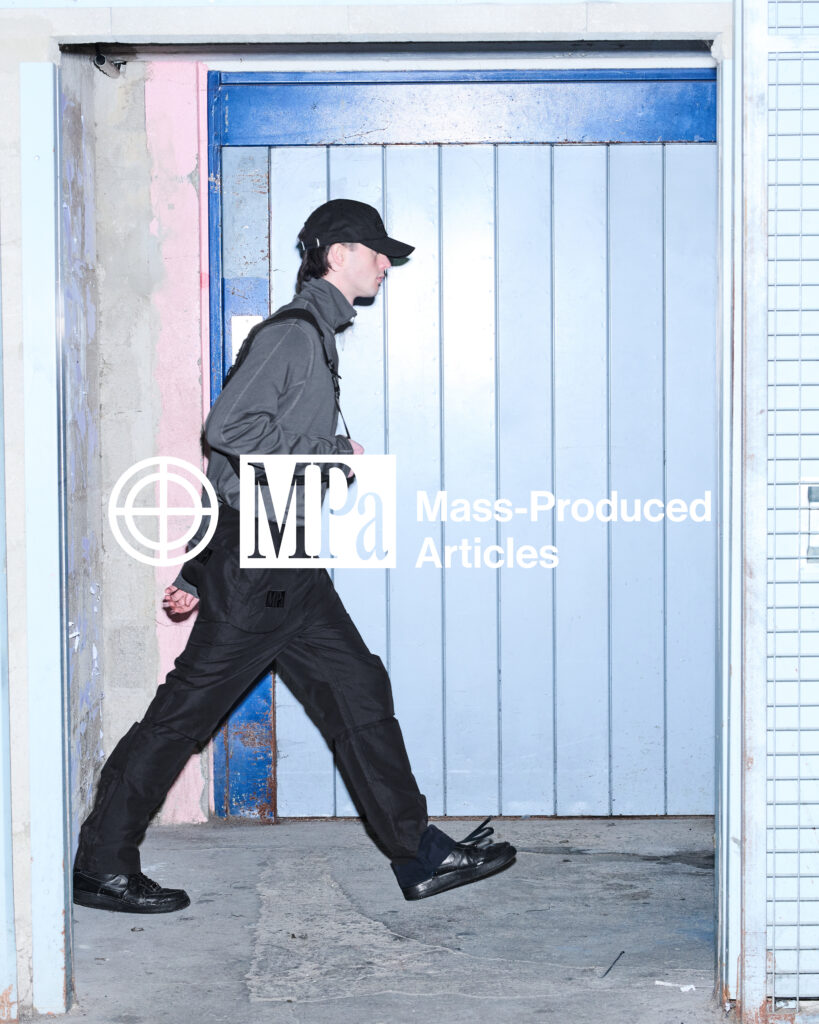
Creative director Mincheol Seo draws inspiration from architecture and explores, through garments and objects, how designed forms influence human consciousness.
I have great respect for architects.
PLASTICPRODUCT is also interested in the energy that emerges from imperfection and failure rather than perfection, and we want to share that energy.
Mincheol Seo
Seo’s conceptual approach to design, together with his exploration of the relationship between fashion and architecture, resonates with the ideas of Alessandro Mendini.
Mendini was an Italian designer and architect born in Milan, and also served as the director of the architecture and design magazine Domus. In presenting his early works, Domus described them as “objects for spiritual use.” *1
These works sought to move beyond the conventional rationality of function that had traditionally been considered inherent to design objects.
He questioned the very logic of functionalism itself, challenging the idea that design should be defined solely through functional criteria.
As far as I am concerned, it is not the project itself that interests me: I use the reality of design not according to its intended purpose, but in order to carry out my natural vital act, which is to produce images.
Alessandro Mendini, 1987
In Domus Moda, the fashion issue of Domus, Mendini also reflected on the relationship between architecture and clothing. *2
I am fascinated by the idea of change. […]
I consider clothing as the smallest form of architecture: the smallest and most refined space constructed around the human body, intimately connected to it — a free and ever-changing habitat.
Alessandro Mendini, 1981
Mendini’s understanding of clothing as a “smallest architecture” closely resonates with Seo’s approach of reconsidering fashion products through an architectural perspective.
MPa SPEED CTRL WATCH ——“Being the Subject of Time“
“Are humans truly rational?”
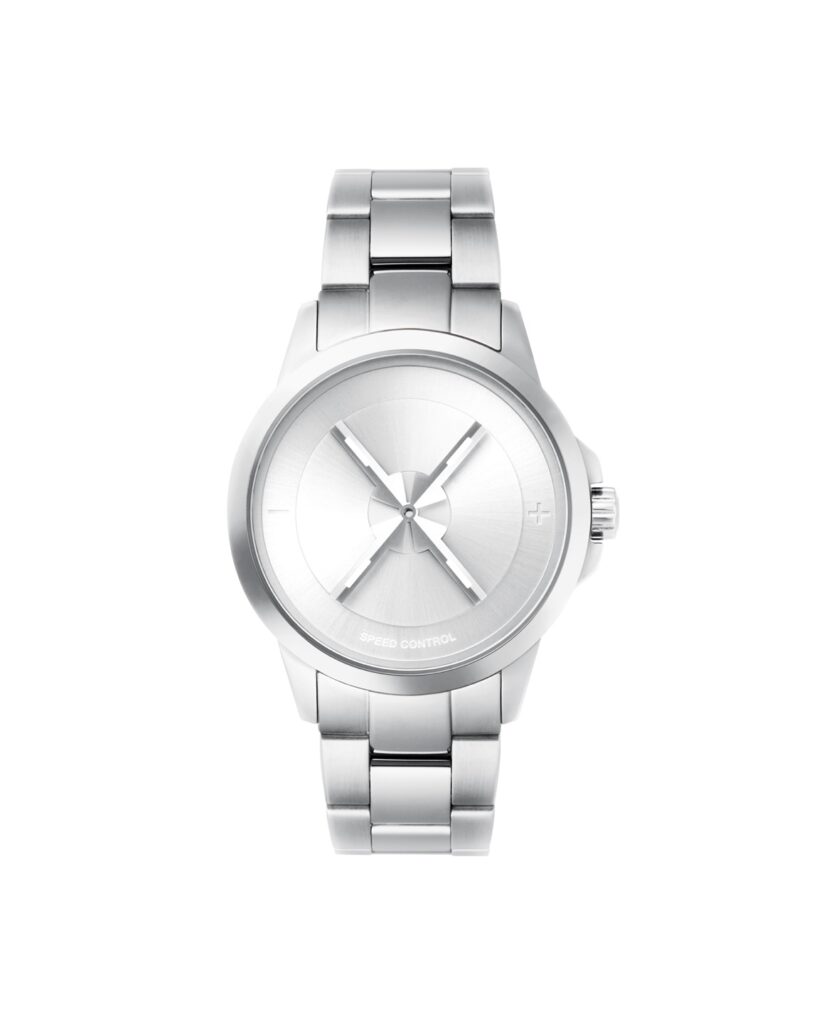
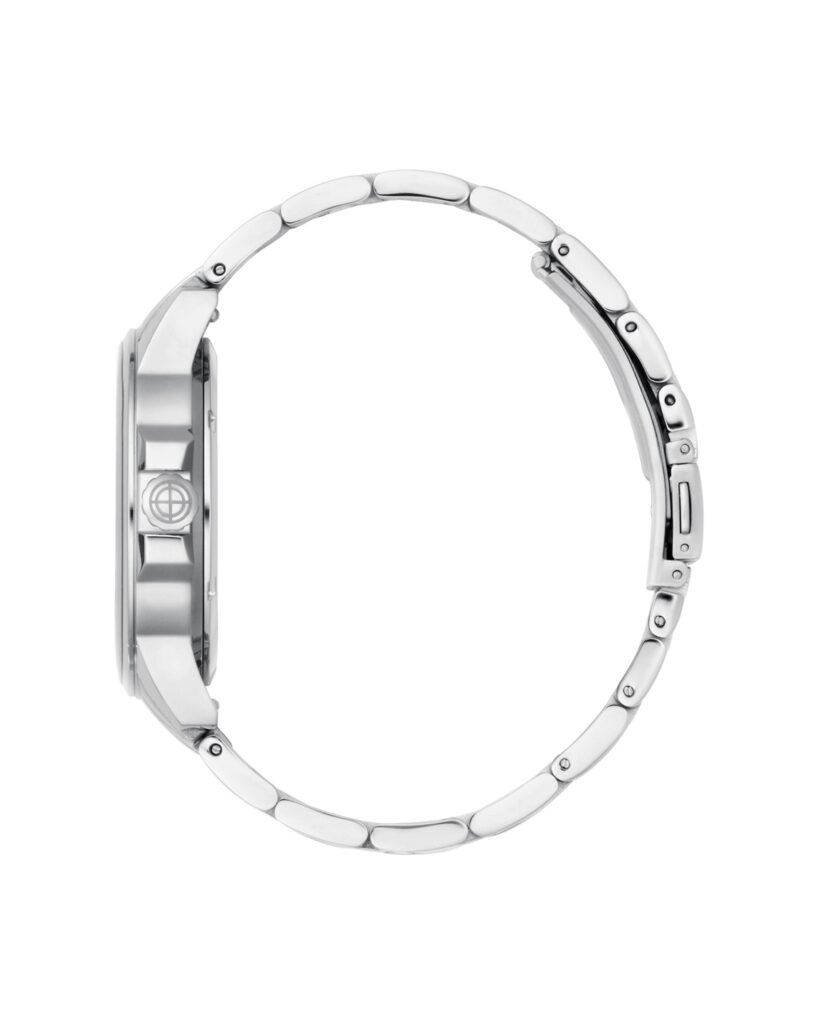
MPa’s design project SPEED CTRL WATCH encourages the wearer to become aware of their own vulnerability and reconsider their relationship with time.
A proposal built on intentionally limiting action. Both the hour and minute hands share the same form and extend in both directions.
This forces the user to wait a full 60 seconds, and only by reflecting on their surroundings and the memories of the day
they can finally perceive the passage of time.PLASTIC PRODUCT
In contemporary society, time is generally understood as something measurable. However, when we reflect on our own psychological state, how do we actually perceive the passing of time? Is time truly stable and constant?
When we pause from the regulated flow of external time and listen to our internal rhythm, how do we feel? Time is not only something controlled externally. It is also shaped by our mental and emotional states.
If architecture protects human space within constantly changing conditions of weather and environment, could a watch become a form of “habitat” within the flow of time — a space that allows individuals to inhabit their own pace?
Only those who control their speed are truly free.
PLASTIC PRODUCT
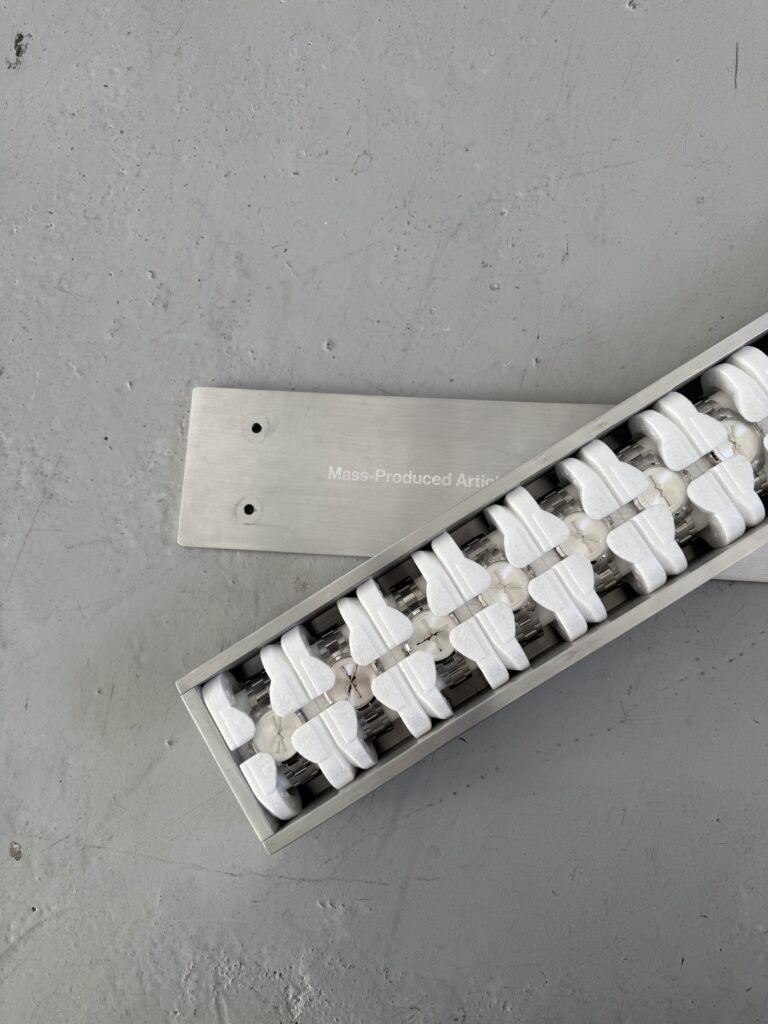
The concept of “speed control,” behind the design of the watch, is one of the essential ideas the MPa project shares constantly.
The MPa SPEED CTRL WATCH later expanded into an installation project. The conceptual design of a wearable object evolved into a spatial experience where “speed control” could be physically encountered through the body.
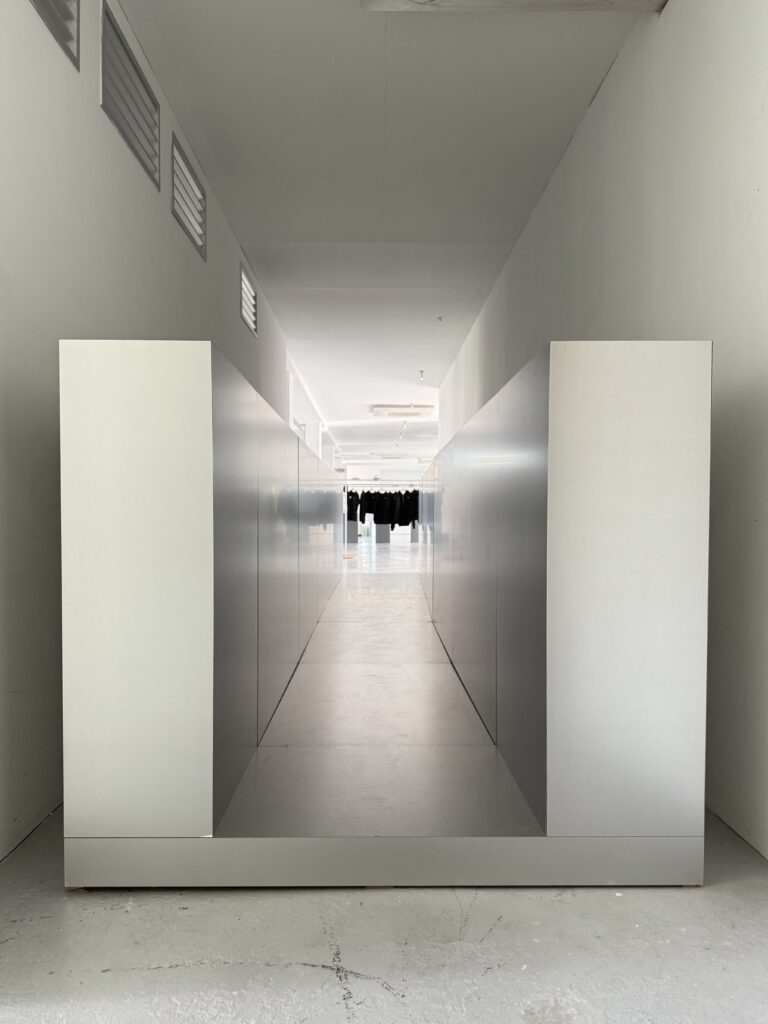
HANGING SOUND ——“Mental Health through Sound”
“Inner Echoes: Exploring Mental Health and Meditation through Sound”
Often referred to as the father of video art, Nam June Paik transformed an existing everyday medium — the television — by reconstructing it as a new artistic form capable of producing and transmitting music. Similarly, through MPa SOUND HANGER, PLASTICPRODUCT reinterprets the familiar object, a hanger as an acoustic device, approaching its function from an entirely different perspective.
In the installation project HANGING SOUND, rather than eliminating noise and distortion — elements normally considered acoustic imperfections — PLASTICPRODUCT places them at the core of the work. Here, sound is no longer treated as a simply medium for transmitting information, but as a perceptual device capable of shifting mental states and directing attention.
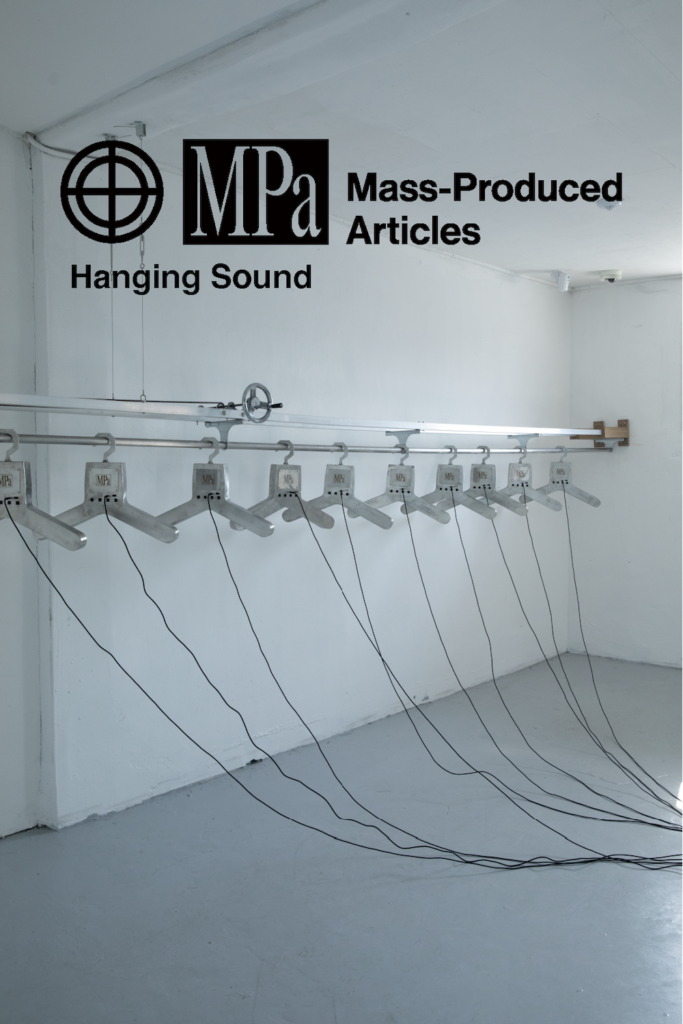
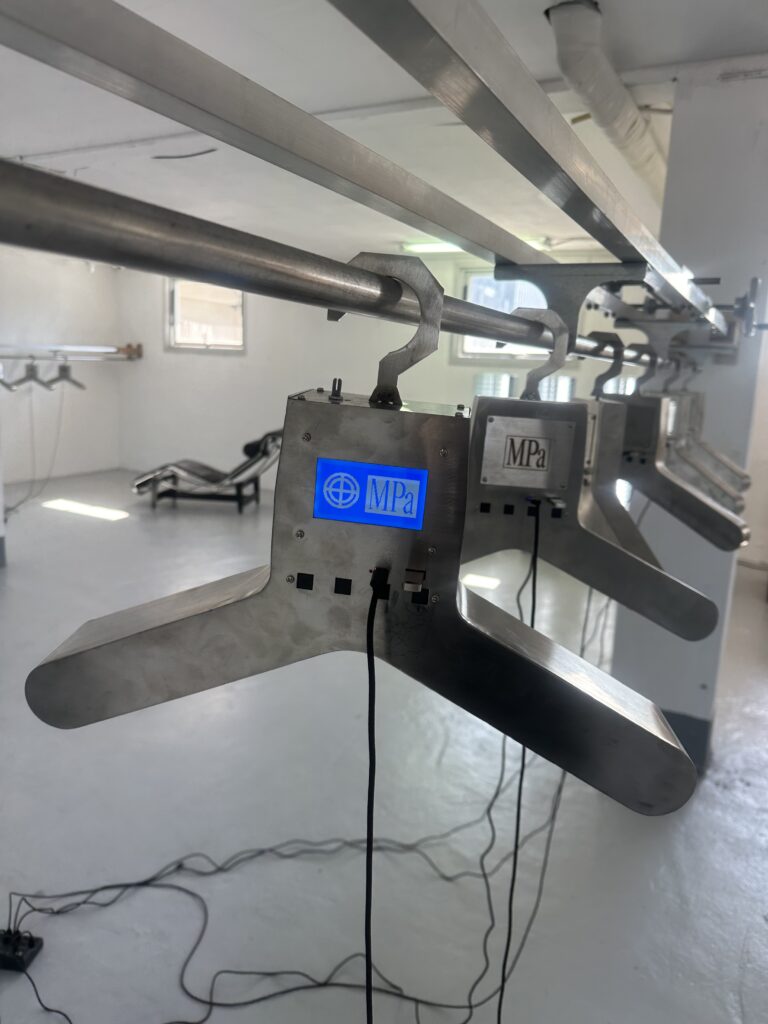
At first, we wanted to create a hanger for ourselves and wanted to incorporate the functionality of a speaker into it. We discovered something unexpected since it was made of stainless steel, it produced only noise instead of clear sound.
Traditionally, speakers are evaluated based on sound quality. However, when we considered the AirPods we use daily, we realized that their value lies more in compactness and convenience rather than superior sound quality.
With this in mind, we recorded and reprocessed the noise generated within our workspace, transforming it into an experience where noise is perceived as white noise.
PLASTICPRODUCT
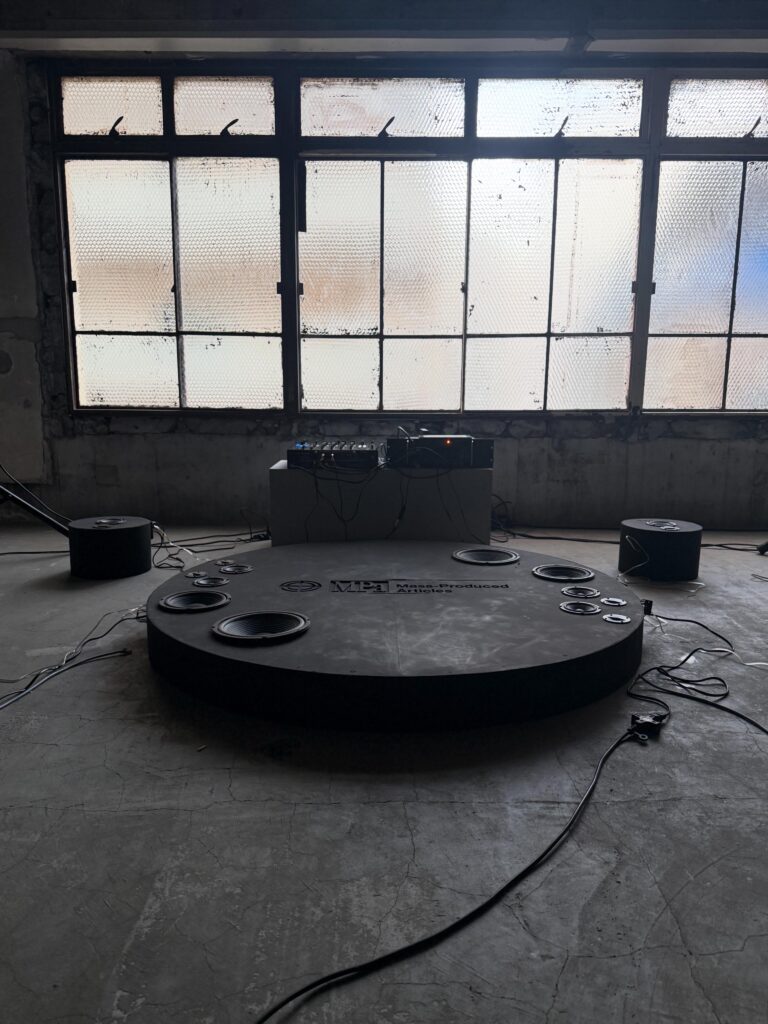
MPa Sound System Discs Tokyo
In May 2026, a live performance by artist VQ was presented at CON Gallery in Nihonbashi Bakurocho, Tokyo.
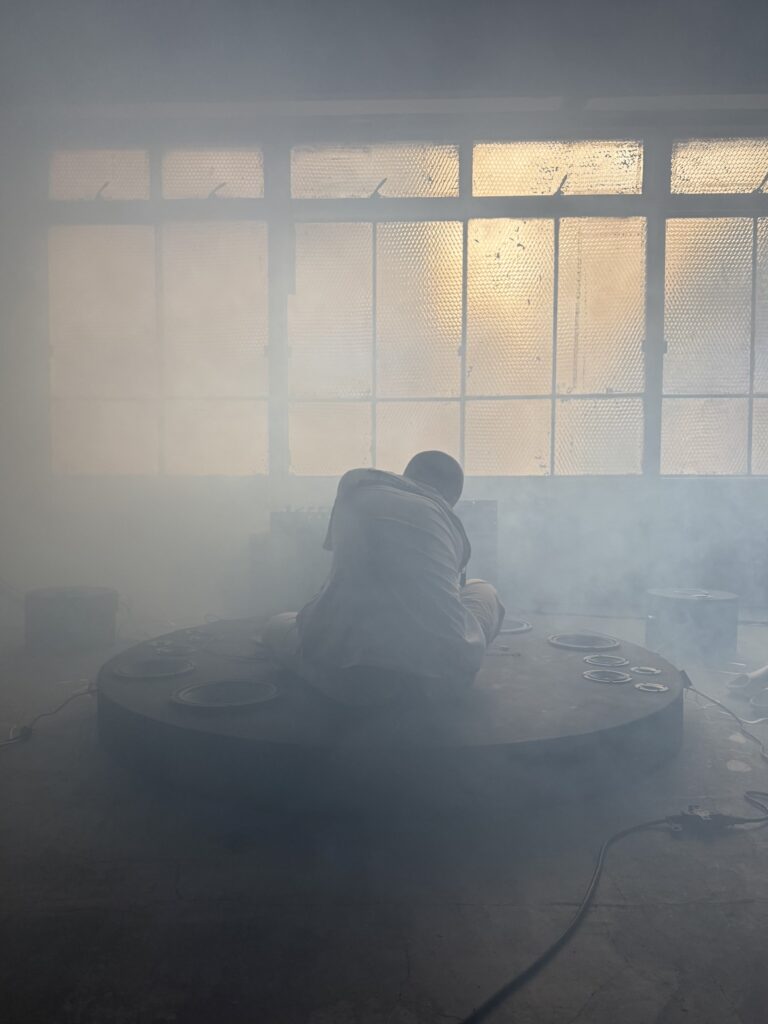
PPLASTICPRODUCT’s exploration of sound and mental awareness further developed into a spatial experience realized in Tokyo. For this immersive live performance, a physical system was constructed in which sound was generated and distributed throughout the space through the central structure of the MPa Disc.
The audience does not simply “listen” to the sound from an external position. By being present in the space, they become physically integrated into the circulation system through which sound travels. Rather than surrounding the performance as passive observers, they are positioned directly on the very circuit that transmits the sound, becoming part of the structure itself.
Through the PLASTICPRODUCT MPa project, the brand continues to develop an experimental and distinctive approach as a fashion brand. Creative director Mincheol Seo talked about how he expands the practice beyond garments into objects, sound, and spatial experiences.
INTERVIEW 1.
HANGING SOUND — Sound, Perception, and the Body
MH
When I hear the phrase “experiments with sound and perception” as I grew up in Japan the first figure that comes to mind is Ryuichi Sakamoto. I also find a connection between PLASTICPRODUCT’s approach and the practice of Nam June Paik, who collaborated with Sakamoto in the field of performance art from an early stage.
Similar to how Paik reconstructed television as an existing medium and transformed it into a new form of expression capable of producing unexpected sounds, I felt that HANGING SOUND creates a new perceptual experience by reinterpreting a hanger—an object never originally intended as an acoustic device—as a speaker system.
At the same time, what makes PLASTICPRODUCT particularly unique is that its exploration begins from fashion products. Compared with other forms of media, fashion operates more directly in relation to the human body, affecting the way we physically sense and perceive the world.
When expanding from wearable objects into spatial installations, what kind of physical and sensory experiences do you aim to create for the audience?
Although each viewer may naturally come to meet different and unexpected interpretations, how did you approach translating sound and perception into a spatial experience through projects such as HANGING SOUND and MPa Sound System Discs Tokyo?
MS
Rather than creating a new “sound,” I am more interested in creating a new system through which sound is transmitted.
HANGING SOUND began by looking at the hanger from a different perspective. When an object originally designed for holding clothes becomes a device for transmitting sound, people begin to perceive the same sound in a completely different way.
MPa Sound System emerged from the same idea. I was not interested in creating music itself, but in proposing a sound system unique to MPa. My interest lies not in what kind of sound is produced, but in the path through which that sound reaches the listener.
For this reason, I did not want to define a specific conclusion or goal for these projects. Instead, I wanted to show that there are countless possibilities within the routes through which sound can travel.
The sound system proposed by MPa is simply one of those possibilities. Through this system, one person may experience discomfort, another may find curiosity or enjoyment, while someone else may arrive at an entirely different emotional response.
I did not want to design that “final destination.” I wanted to present only a new pathway, leaving where each person arrives as part of their own individual experience. I believe that openness is essential to the nature of this project.
Of course, throughout the process of creation, I had certain emotions and atmospheres that I personally hoped to evoke. However, I did not want to present them as the only correct interpretation.
INTERVIEW 2.
Brand Narratives: Experimentations and Communication
MH
PLASTICPRODUCT is often described as an “experimental” brand.
However, what interests me most is not only the products themselves, but also the way you construct a consistent worldview through various forms of expression, including installations, ZINEs, and visual communication.
From your perspective, what fundamental themes or questions are you coherently exploring throughout PLASTICPRODUCT’s practice, regardless of medium or genres?
MS
What we are exploring is a new perspective, and another perspective.
Rather than accepting existing concepts, we continue to ask: “Could there be a better way of seeing this?” This pursuit of perspective defines our core value.
Utility wear, plastic, silver cars, plain T-shirts with only an inorganic logo, sound systems—everything we have worked with began from the same question: “Is there another way to look at this?”
What we want to share is this way of thinking.
INTERVIEW 3.
MPa Sound System Discs Tokyo — Tokyo and Its Sensibilities
MH
In MPa Sound System Discs Tokyo, Tokyo was chosen as the location for the installation.
Was there any particular intention or background behind selecting Tokyo as the location for this project?
Did you feel any resonance between Korean and Japanese cultures or sensibilities when developing and presenting works?
Personally, I often feel a certain closeness in K-music and art. Although I currently live in Italy, where I do not often encounter Japanese cultures, I feel a familiar comfort whenever I encounter Korean artists, music, and food.
In some ways, I feel that Korean artistic expressions often carry a poetic quality that deeply resonates with me—perhaps even something close to “meditation” through language.
Do you also find any similarities or differences between these cultural contexts?
MS
I feel that Japan has a culture of observing things carefully, taking time to reflect, and thinking quietly.
This performance was an attempt to propose a new pathway through which sound can travel. For that reason, rather than presenting a single answer, I felt that Tokyo was an appropriate place because it is a city where diverse interpretations and reflections can naturally emerge.
INTERVIEW 4.
HANGING SOUND — Materiality and Unexpected Noise
MH
In HANGING SOUND, I was particularly interested in the way you embrace the nature of stainless steel—something usually considered an acoustic fault—and positioning the noise as the central element of the work.
This approach reminded me of the way artists associated with Mono-ha by Lee Ufan, accepted the inherent qualities of materials and became the center of artistic expression.
In your creative practice, are there influences that come from fields outside of fashion, such as contemporary art, music, architecture, or philosophy?
Are there any artists you frequently engage with?
MS
I do not think that I am directly influenced by one specific artist.
However, I have great respect for architects.
I believe architecture is an extremely powerful medium, one that can transform human movement, perception, and even relationships between people. I have always felt admiration and respect for this mighty power. This is also because, through my own practice, I hope to become something that can create an influence on people in some way.
Among musicians, I particularly like Autechre.
What attracts me is not simply their sound, but their approach of continuously exploring new possibilities by building their own systems and languages rather than repeating existing formats.
I am also more interested in creating systems that allow new perspectives and experiences to emerge, rather than simply producing a completed work.
INTERVIEW 5.
Spatial Design Tells Brand Story
MH
I came across a post on @nonfictionhome’s Instagram featuring a collaboration with PLASTICPRODUCT.
Is this part of a new project related to spatial design or architecture?
If possible, I would love to hear more about the background of this project and what PLASTICPRODUCT is exploring through space as a medium.
MS
Together with the Nonfiction Home team, we created a new space: the PLASTICPRODUCT Hannam Store.
The store also includes a residential space called MPa Residence.
Our mission was to create an attractive environment while preserving the DNA and identity of both PLASTICPRODUCT and MPa.
During this process, Nonfiction Home discovered a shared value between PLASTICPRODUCT and the work of Umberto Riva.
We strongly connected with Riva’s exploration of instability, imperfection, and failure. PLASTICPRODUCT is also interested in the energy that emerges from imperfection and failure, rather than from the pursuit of perfection, and we hope to share that perspective.
For this reason, we partially referenced the structure of Riva’s Casa Maria Bottero, and translated its principles into the space through our own approach.
We also wanted to bring a sense of private energy into a public environment, creating an experience that feels slightly unfamiliar and unexpected for visitors.
Visitors first move through a dense and warm residential atmosphere, and then encounter the PLASTICPRODUCT showroom, which has a dry space defined by emptiness.
This is a project and a space that I personally feel very connected to.
*1 Domus, Alessandro Mendini. https://www.domusweb.it/it/progettisti/alessandro-mendini.html
*2 Mendini, A. (1981a). Cosmesi Universale. Domus Moda, allegato a Domus, 617, 1.
Paola Maddaluno, INSCRIVERE LA MODA NEL DESIGN: ALESSANDRO MENDINI E DOMUS MODA 1981-85, in AIS/DESIGN JOURNAL STORIA E RICERCHE VOL. 3 / N. 6 SETTEMBRE 2015.
2026. 8. 10