Archive
Master’s Research
Japanese Avant-Garde Fashion Beyond the Garment: Deconstruction, Installation, and Collaborative Practice
Master’s Thesis, Università di Bologna, 2026
This dissertation examines the research question: How have Japanese fashion designers and
brands translated deconstruction and the decentering of human agency through fashion
design, performance, and visual communication? As a research gap, while fashion
communication has been widely studied within industry-oriented frameworks, editorial
imagery, runway presentations, and fashion media are rarely examined as curatorial materials
or as interdisciplinary systems shaped by collaboration across artistic, technological, and
performative fields.
This study therefore approaches Japanese fashion media not only as commercial
communication, but as a collective visual practice that constructs cultural narratives through
images, performance, materiality, and spatial experience.
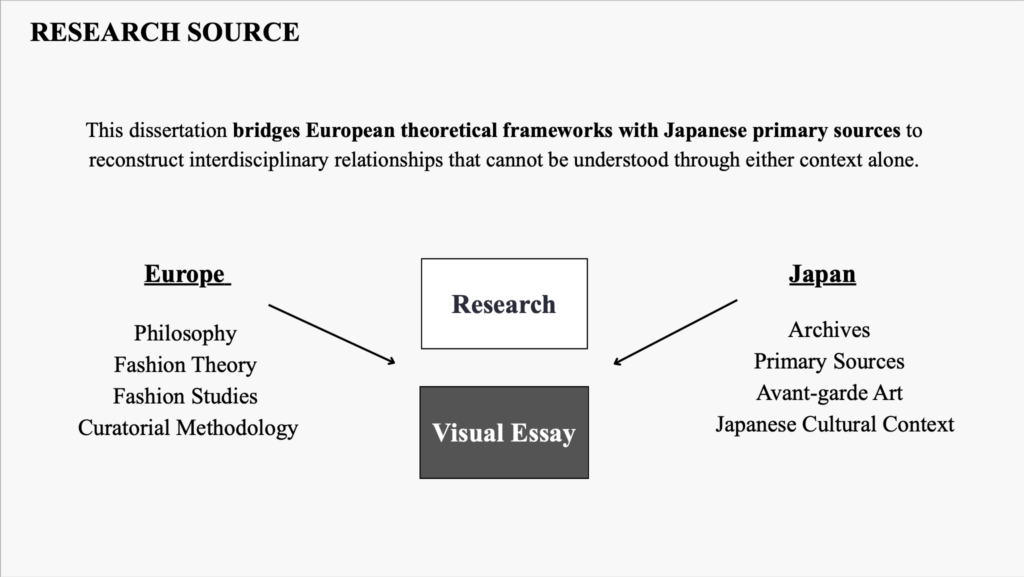
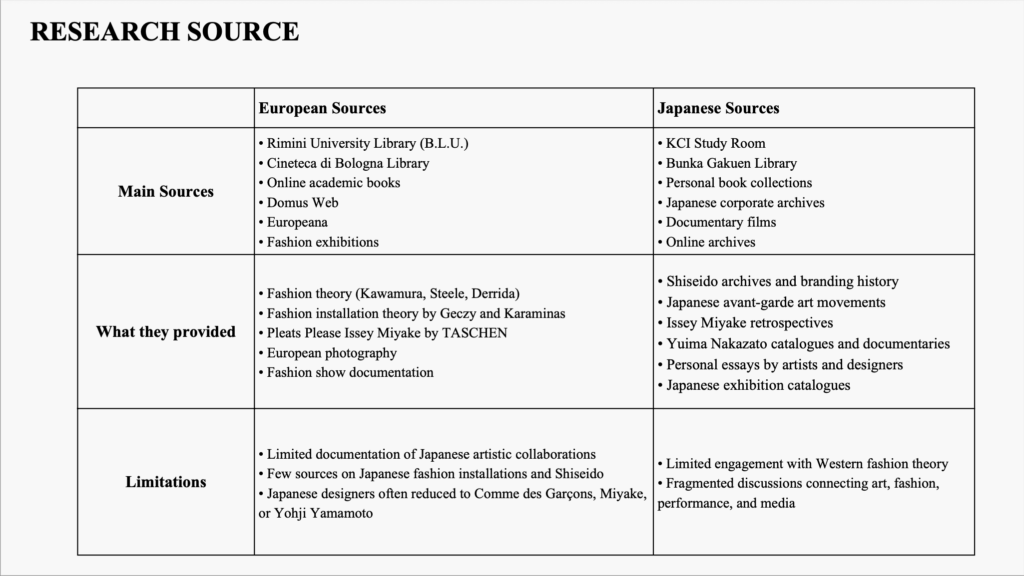
Methodologically, the research combines visual and media analysis with archival research,
with particular focus on editorial photography, advertising campaigns, runway documentation,
films, exhibitions, and photographic archives.
The study focuses on post-war Japanese avant-garde movements, alongside case studies of
Shiseido, Issey Miyake’s Pleats Please, and Yuima Nakazato’s contemporary couture practice.
In addition, the project includes a practice-based component in the form of a visual essay,
which rearticulates the dissertation’s key themes through curatorial sequencing and visual
juxtaposition.
This study demonstrates that Japanese fashion communication extends beyond garment
representation and operates as a collaborative visual system involving designers,
photographers, makeup artists, choreographers, musicians, engineers, and other practitioners.
Shiseido’s visual communication strategies, developed through collaborations with
avant-garde artists, redefined notions of Japaneseness and Asianness within modern
advertising and editorial formats. Issey Miyake’s Pleats Please reconfigured the relationship
between body and garment through textile innovation, technological development, and an
emphasis on movement and everyday use. Yuima Nakazato further extends these concerns
through material experimentation, circular production systems, and installation-based
presentations that integrate clothing, environment, and human existence.
This dissertation argues that Japanese fashion translates deconstruction not only as a visual
strategy but as a material and collaborative practice that redefines relationships between body,
clothing, technology, media, and environment, thereby challenging Western-centred
understandings of beauty, authorship, and fashion production.
Research Question
“How have Japanese fashion designers and brands translated practices of deconstruction and the decentering of human agency through fashion design, performance, and visual communication?”
Keywords
Deconstruction / Fashion communication / Installation / Interdisciplinary collaboration / Japanese fashion / Visual essay
Volume
168 pages
研究概要
本研究は、「日本のファッションデザイナーやブランドは、ファッションデザイン、パフォーマンス、ビジュアルコミュニケーションを通じて、脱構築および人間中心的な価値観の転換をどのように表現してきたのか」という問いを出発点としています。
これまでファッションコミュニケーションは、主に産業的・商業的な枠組みの中で研究されてきました。一方で、エディトリアル写真、ファッションショー、ファッションメディアは、「キュレーションの対象、あるいは芸術・技術・身体表現など異なる領域のコラボレーションによって形成されるもの」という視点では十分に考察されてきませんでした。
本研究では、日本のファッションメディアを単なる商業的コミュニケーションとしてではなく、イメージ、身体表現、素材、パフォーマンス、空間を通じて文化的なナラティブを構築する「集合的なビジュアル実践」として捉えています。
研究方法として、ビジュアル分析およびメディア分析とアーカイブ研究を組み合わせ、エディトリアル、ファッション写真、広告、ランウェイ・パフォーマンス形式のコレクションプレゼンテーション、ドキュメンタリー映画を中心に考察しました。
対象として、戦後日本のアヴァンギャルドファッションの系譜を軸に、資生堂の広告、「Pleats Please Issey Miyake」、現在日本から唯一オートクチュール公式デザイナー(ゲストデザイナーとしてパリコレ参加)として認定されているYuima Nakazatoをケーススタディーとして取り上げました。
さらに、研究の実践的成果物としてビジュアルエッセイを制作しました。研究で導き出した答えを文章ではなく、一つのナラティブ(物語)をビジュアルの配置のみで表現する形で、視覚的に編集・再解釈しました。
本研究は、日本のファッションコミュニケーションが単なる「衣服」を超え、デザイナー、写真家、メイクアップアーティスト、振付家、音楽家、エンジニアなど、多様な表現者によるコラボレーションによって「脱構築」というメッセージ性を生み出していることを示しています。
資生堂のビジュアルコミュニケーションは、国際的なブランドイメージを創出する上で、アヴァンギャルドアーティストとのコラボレーションを通じて、広告において「日本らしさ」や「アジア性」をあえて全面的に自己演出することで、「伝統的な日本の美意識」を現代風に再解釈しました。
「Pleats Please」は、テキスタイル技術のイノベーション、縛りのない身体性の自由、日常性への着目によって、身体と衣服の関係性を再構成しました。
また、Yuima Nakazatoは、エンジニアとの協業による素材実験、衣服の循環型生産システム、従来のランウェイ形式とは異なる、インスタレーション的アプローチでコレクションを発表し、衣服・環境・人間の関係性を根本から見つめ直し、デザイナー自身の「自然と土地を旅した記憶」を再現する演出で、パリの舞台で「衣服とは何か」を問いかけます。
本研究は、日本のファッションにおける脱構築が、表面的な視覚的表現にとどまらず、「身体、衣服、テクノロジー、メディア、環境の関係性の再定義」という共通のビジョンのもと、素材開発・衣服デザイン・システム・「美しさ」の概念の再構築による実践であると強調します。アーティスト同士のコラボレーションにより、未だ西洋中心的ファッションのあり方に対し、新たな視点を提示し続けています。
Contemporary fashion practice is increasingly confronted with broader social, ecological, and
cultural questions beyond seasonal consumption and image production. In recent years,
designers, architects, and artists have attempted to reconsider existing systems of production
and representation through alternative approaches that integrate technology, material
experimentation, and interdisciplinary collaboration, moving toward new forms of
deconstruction that decenter human agency.
These approaches resonate with broader discourses surrounding deconstruction and
alternative design systems that became particularly influential during the late twentieth
century. In fashion history, Japanese avant-garde designers, including Rei Kawakubo, Yohji
Yamamoto, and Issey Miyake challenged conventional Western ideals of beauty, gender, and
bodily representation through experimental silhouettes, material innovation, and alternative
understandings of clothing. Their practices transformed international fashion discourse by
introducing new relationships between body, movement, technology, and space. In the
twenty-first century, contemporary designers such as Nakazato have further extended these
concerns toward questions of environmental sustainability, circular systems, and
post-industrial modes of clothing production.
In Japan, architect Kengo Kuma argues that digital technologies enable continuous processes
of modification and aggregation, proposing forms of architecture based not on fixed
monumental structures but on flexible systems composed of smaller, interconnected
elements.1 This perspective can be connected to Yuima Nakazato’s modular garment system,
which integrates technological innovation with reparability and alternative models of clothing
production.
At the same time, fashion communication has evolved far beyond the garment itself. Runway
presentations, editorial photography, advertising campaigns, film, performance, scenography,
music, and installation design have become essential components in constructing the cultural
meaning of fashion. These interdisciplinary collaborations often intersect with broader artistic
movements including Minimalism, Fluxus, performance art, and Mono-ha. Such connections suggest that fashion communication may be understood not only as commercial media, but
also as a collective visual and spatial practice.
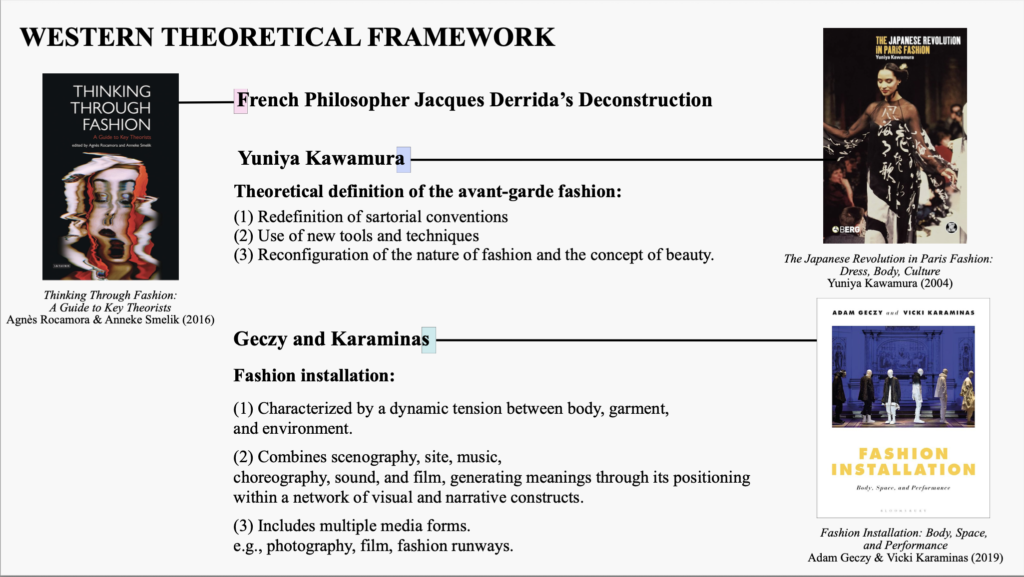
This dissertation builds upon the theoretical framework proposed by Adam Geczy and Vicki
Karaminas in Fashion installation: Body, space, and performance (2019), which
conceptualises fashion presentation as an interdisciplinary assemblage combining garment,
site, choreography, sound, film, and scenography. Their approach provides a useful
foundation for reconsidering fashion communication as a form of installation practice and
expanded visual culture.
However, existing research remains limited in several important aspects. Fashion
communication is still predominantly examined within industry-oriented frameworks, while
runway imagery and editorial photography are rarely approached as curatorial material
capable of generating new public engagement outside fashion audiences. Furthermore,
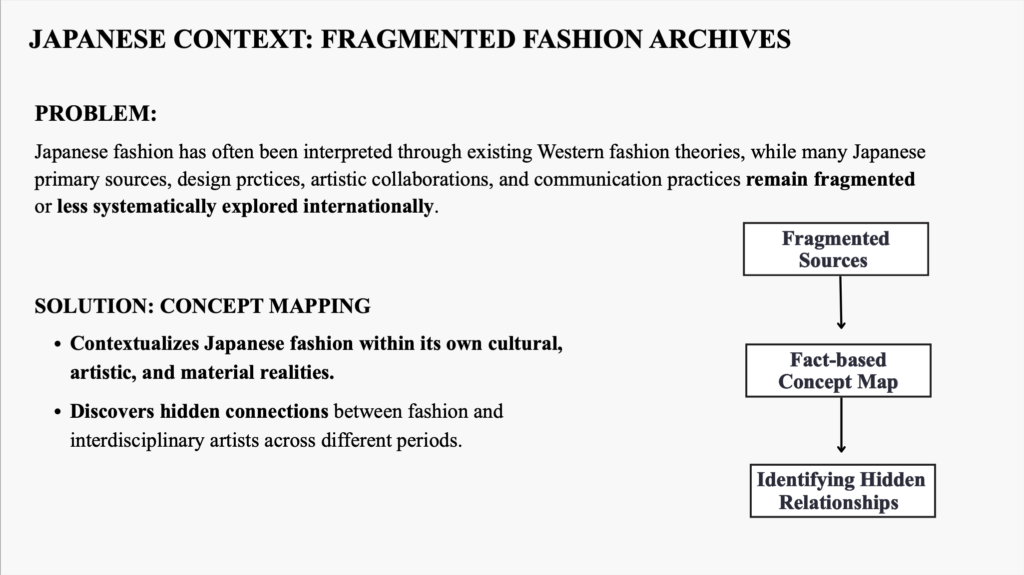
Japanese fashion has frequently been interpreted through established Western curatorial
narratives, while limited attention has been paid to fashion media as an interdisciplinary and
collaborative installation system.
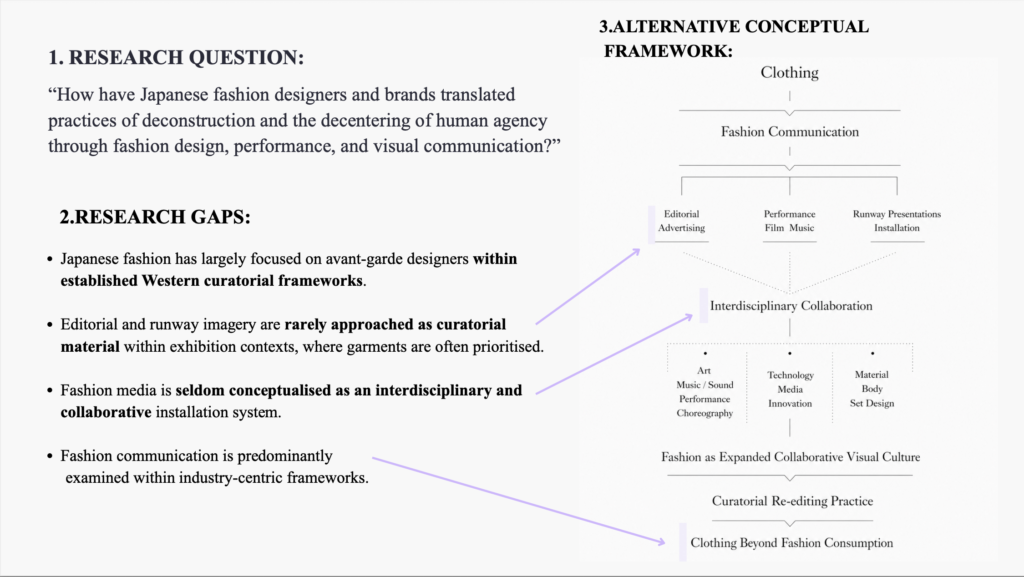
This dissertation therefore asks: How have Japanese fashion designers and brands translated
practices of deconstruction and the decentering of human agency through fashion design,
performance, and visual communication?
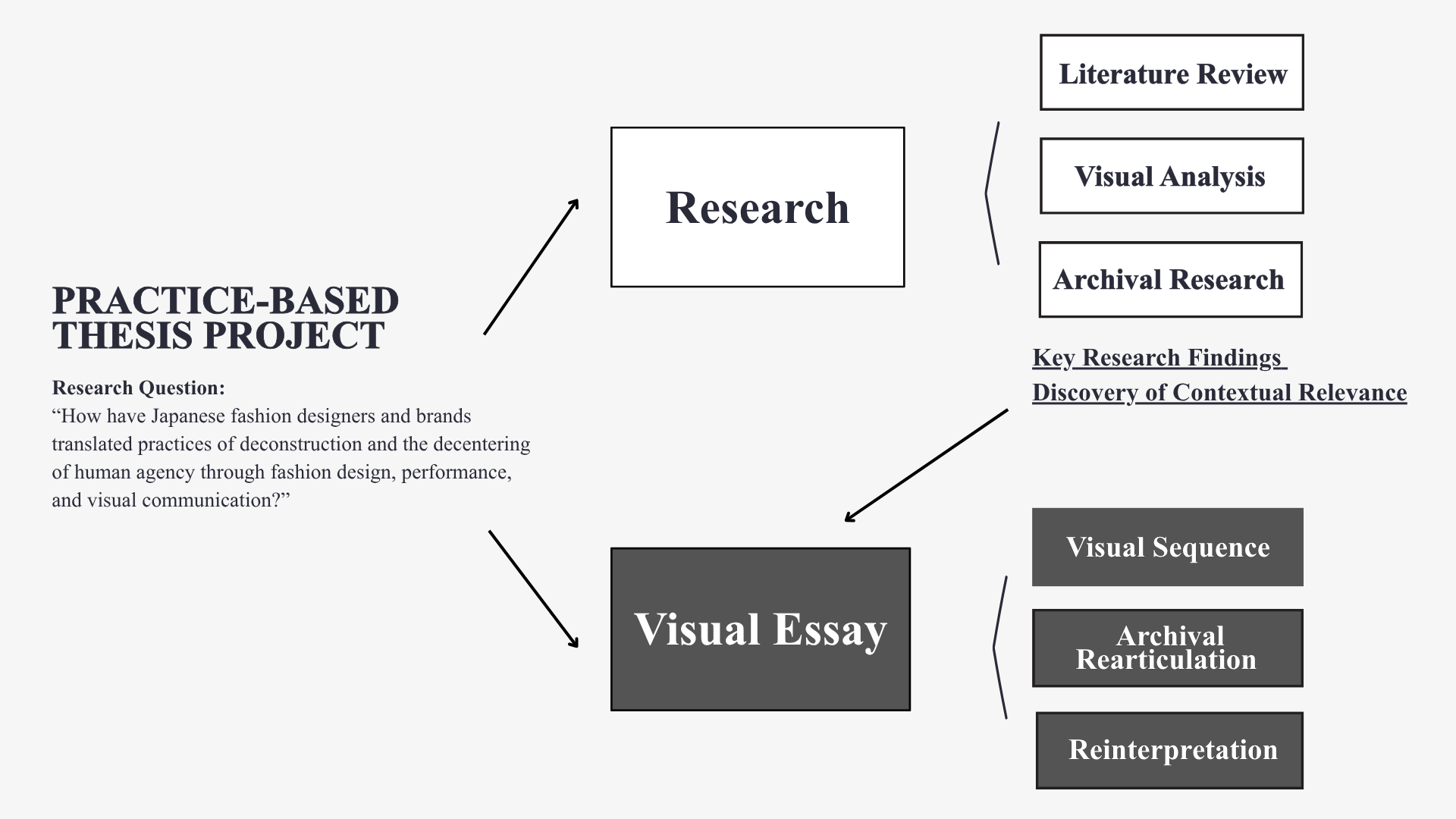
Methodologically, the research combines visual analysis, media studies, and archival research.
Editorials, runway documentation, advertising campaigns, films, and photographic archives
are analysed as visual communication systems that construct cultural narratives surrounding
clothing and identity. The project also incorporates a practice-based component through the production of a visual essay, which, building on the key themes, explores how such relationships may be communicated through visual sequencing and curatorial editing.
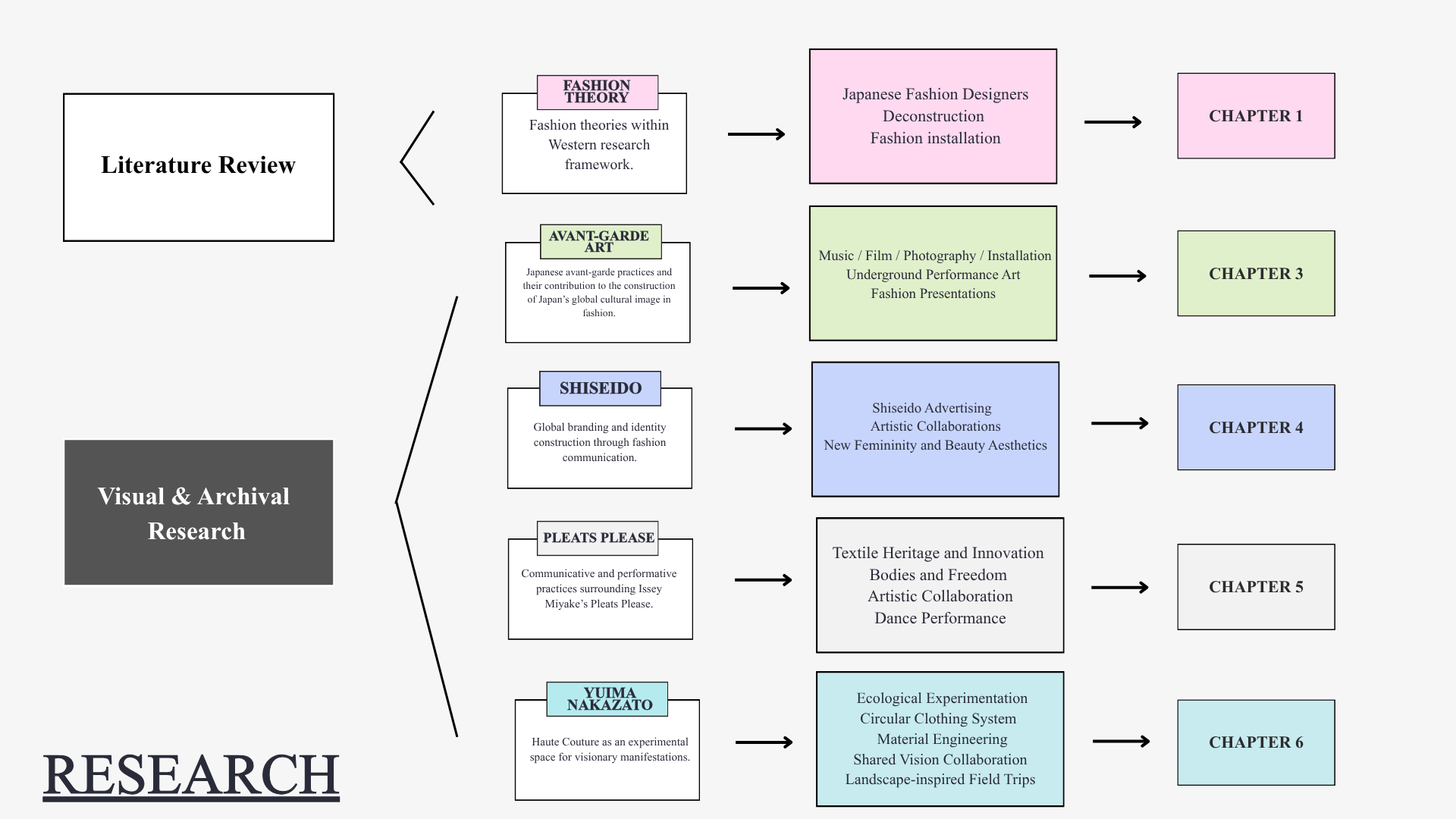
The dissertation is structured across seven chapters. Chapter 1 examines theories surrounding Japanese fashion designers and deconstruction, as well as fashion installations within a
Western research framework. Chapter 2 outlines the methodology and research framework.
Chapter 3 analyses postwar Japanese avant-garde practices, focusing on how artists across
music, performance, and visual culture contributed to the construction of Japan’s global
cultural image and its translation into fashion presentation. Chapter 4 analyses visual communication and identity construction through Japanese fashion-related media, with particular focus on Shiseido advertising and cross-disciplinary collaborations. Chapter 5 investigates the communicative and performative practices surrounding Issey Miyake’s Pleats Please, particularly in relation to material innovation, bodily movement, and artistic collaboration. Chapter 6 focuses on Yuima Nakazato and examines contemporary fashion communication through couture presentation, documentary practice, and ecological experimentation, while analyzing his circular system design through the reconfiguration of clothing structures. Chapter 7 presents a visual essay as a practice-based output that re-edits fashion communication archives to explore how the relationships discussed in the dissertation may be rearticulated through visual sequencing rather than analytical text.
In conclusion, this dissertation argues that Japanese fashion operates as a field in which
deconstruction is not only conceptual but materially and visually enacted through garment
design, bodily performance, material experimentation, visual communication, and interdisciplinary collaboration, thereby challenging Western-centred understandings of beauty, the body, authorship, and fashion production.
研究サマリー
ファッション業界は、シーズンごとの消費を超え、社会的・環境的・文化的な問いと向き合う段階にあります。近年では、デザイナー、建築家、アーティストたちが、テクノロジー、素材研究、コラボレーションを通じて既存の生産システムや表現方法を再考し、人間中心主義(Anthropocentrism)的価値観を問い直す新たな「脱構築」の可能性を探究しています。
このようなアプローチが生まれた背景として、20世紀後半に大きな影響を与えたフランスの哲学者、ジャック・デリダの「脱構築」に関連して考えることができます。ファッションの歴史においては、川久保玲、山本耀司、三宅一生をはじめとする日本のアヴァンギャルドデザイナーが、実験的なシルエット、革新的な素材開発、日本的な身体的解釈を提示することで、西洋的な美の基準、ジェンダー、身体表象の概念を「脱構築」しました。
彼らのデザインは、身体・衣服・動き・テクノロジー・空間の新たな関係性を提示し、国際的にファッションの議論に大きな影響を与えました。21世紀には、中里唯馬をはじめとする現代のデザイナーが、素材研究、循環型生産システム、環境との関係性を取り入れながら、衣服デザインの新たな可能性を拡張しています。
日本の建築家である隈研吾は、デジタル技術によって、固定された巨大な構造物ではなく、小さな要素が相互につながりながら変化する柔軟な建築(=負ける建築)の可能性を提示しました。この考え方は、修復可能性やモジュール型生産システムを取り入れるYuima Nakazatoの衣服デザインのあり方と重ねて考えることができます。
同時に、現代のファッションコミュニケーションは、衣服そのものを超えた意味を生み出します。ランウェイショー、エディトリアル写真、広告キャンペーン、映像作品、パフォーマンス、舞台美術、音楽、インスタレーションなどは、ファッションの文化的意味を形成する重要な要素でもあります。
そこで行われる異分野同士のコラボレーションは、ミニマリズム、フルクサス、パフォーマンスアート、もの派などの芸術運動と関連して考えることができ、その結果、ファッションコミュニケーションは単なる商業的な情報発信ではなく、身体、空間、素材、時間、他者との関係性によって構成される集合的なビジュアル表現して捉えられます。
本研究では、Adam GeczyとVicki Karaminasによる『Fashion Installation: Body, Space, and Performance』(2019)で提示された理論的枠組みを基盤としています。彼らは、ファッションプレゼンテーションを、衣服、空間、振付、音響、映像、舞台デザインが融合する「生きた集合体 “Living Assemblage”」(=ファッションインスタレーション)として捉えています。この視点は、ファッションコミュニケーションをコンセプチュアルなインスタレーション、ビジュアルカルチャーと捉え、再考する上で重要な基盤となります。
しかし、これまで行われてきた既存の研究には、課題が残されています。ファッションコミュニケーションは依然として産業的・商業的な枠組みに限定し研究されることが多く、ランウェイ映像やエディトリアル写真が、ファッションの専門領域を超えて、新たなキュレーション・鑑賞体験を生み出すアーカイブ素材として分析される機会は現状限られています。
また、日本のファッションはこれまで西洋中心の解釈から語られることが多く、異なる芸術領域が交差するコラボレーション的アート表現として、また、日本独自の文脈をベースとした研究は今も十分ではありません。
そこで本研究では、「日本のファッションデザイナーやブランドは、デザイン、パフォーマンス、ビジュアルコミュニケーションを通じて、脱構築および人間中心的な価値観の転換(decentering human agency)をどのように表現してきたのか」を問いとし、そこで導き出した答えをビジュアルの配置やキュレーションを通じてどのように表現できるか、ビジュアルエッセイの制作により探究しました。
Abstract
Acknowledgements
Table of Contents
List of Figures
Introduction
Chapter 1 Fashion Theory and Japanese Avant-Garde Deconstruction
1.1 Deconstructive Frameworks in Japanese Avant-Garde Fashion
1.2 Fashion Installation and Collaboration as a Structural Condition
1.3 Research Gap
Chapter 2 Methodology
Chapter 3 Deconstruction in Avant-garde Japanese Art since the Late Twentieth Century
3.1 Media Across Music, Fashion, Film, Performance Art, and Installation in Post-War
Japan
3.2 Ryuichi Sakamoto and Experimental Media Performance: Technological and
Environmental Materiality
3.3 Underground Performance Art as Counterculture
3.4 Japanese Fashion Presentations as Comprehensive Performance Art
Chapter 4 Shiseido as a Mediator of Avant-Garde Fashion Communication
4.1 Media and Communication for Global Branding
4.2 Key Artistic Collaborations for Shiseido Campaigns: New Femininity and Beauty
Aesthetics
4.3 Shiseido and Fashion Designers
Chapter 5 Issey Miyake’s Pleats Please: Bodies, Performance, and Artist Collaboration
5.1 The Birth of Pleats Please: From Textile Heritage to Technological Design
5.2 Pleats Please and Dance Performance
5.3 Expanded Visual Practices of Pleats Please
4Chapter 6 Yuima Nakazato: Haute Couture as Experimental Installation
6.1 Educational Background at the Royal Academy of Fine Arts in Antwerp
6.2 Nakazato’s Overarching Characteristics: Attitudes, Technologies and Materials
6.3 Fashion Presentation as a Shared Vision Installation
Chapter 7 Visual Essay: Reassembling Key Themes through Curatorial Juxtaposition
7.1 Why Visual Essay?
7.2 Curatorial Methodology
7.3 Visual Essay Sequences
Conclusion
References
Appendices
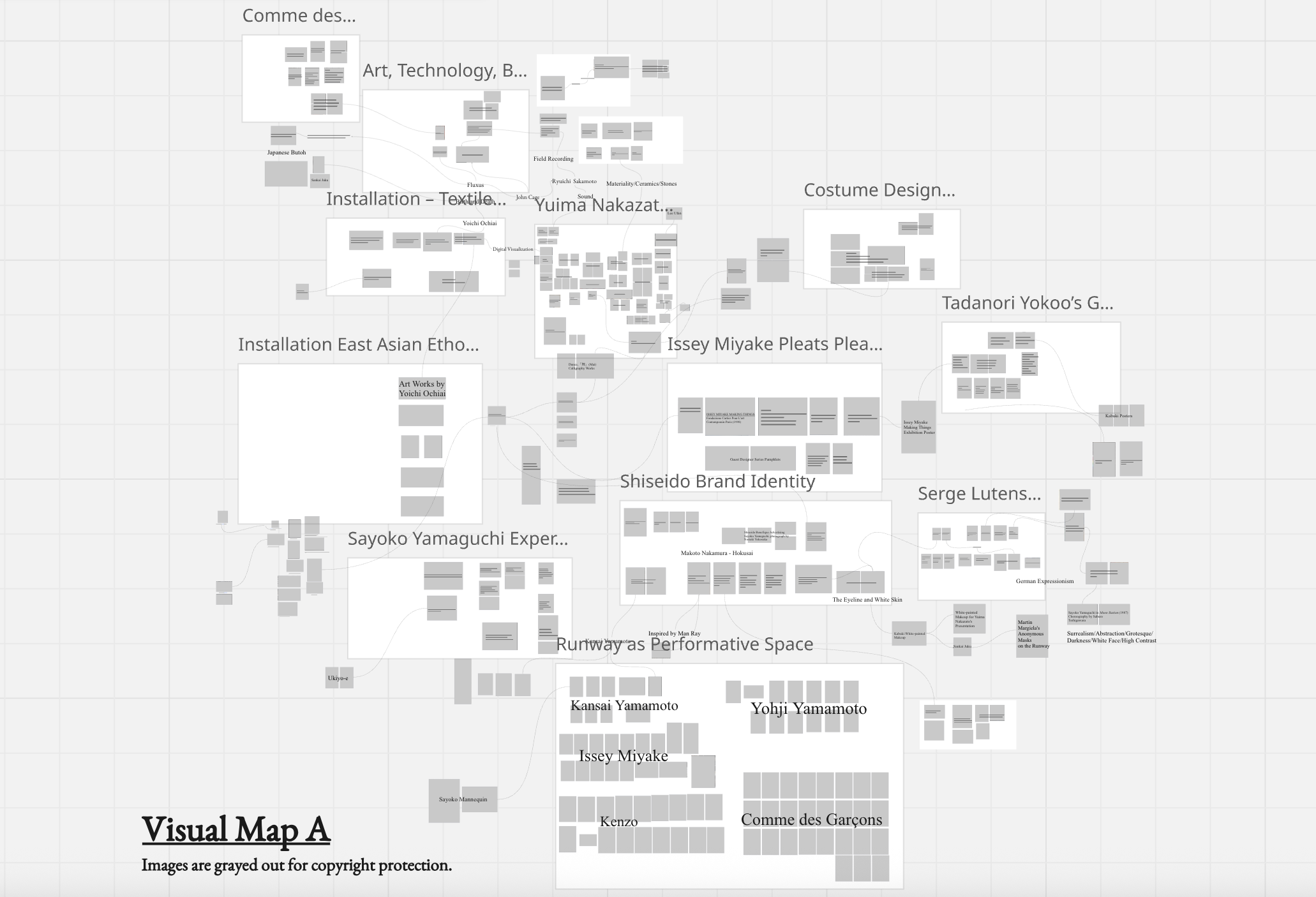
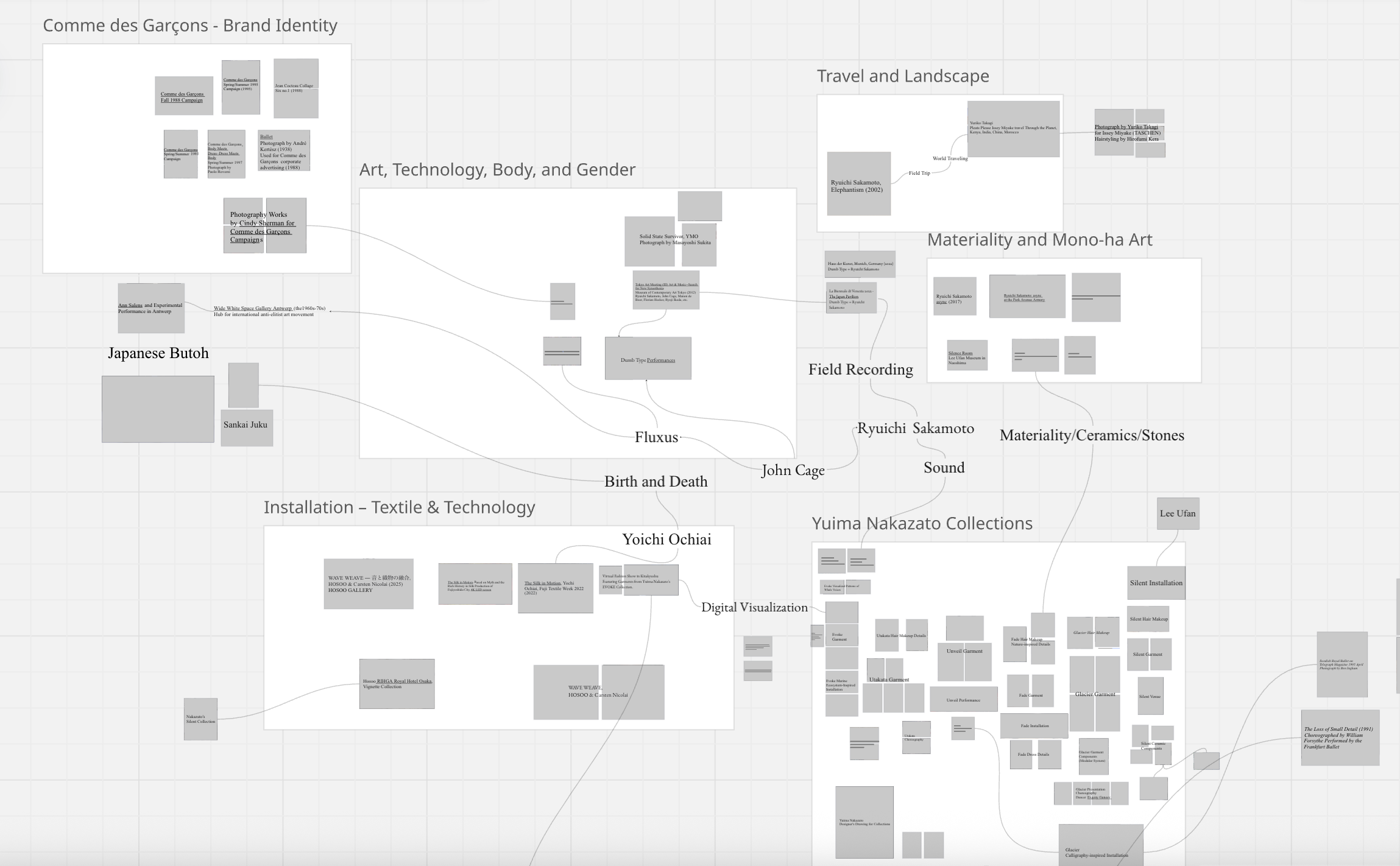
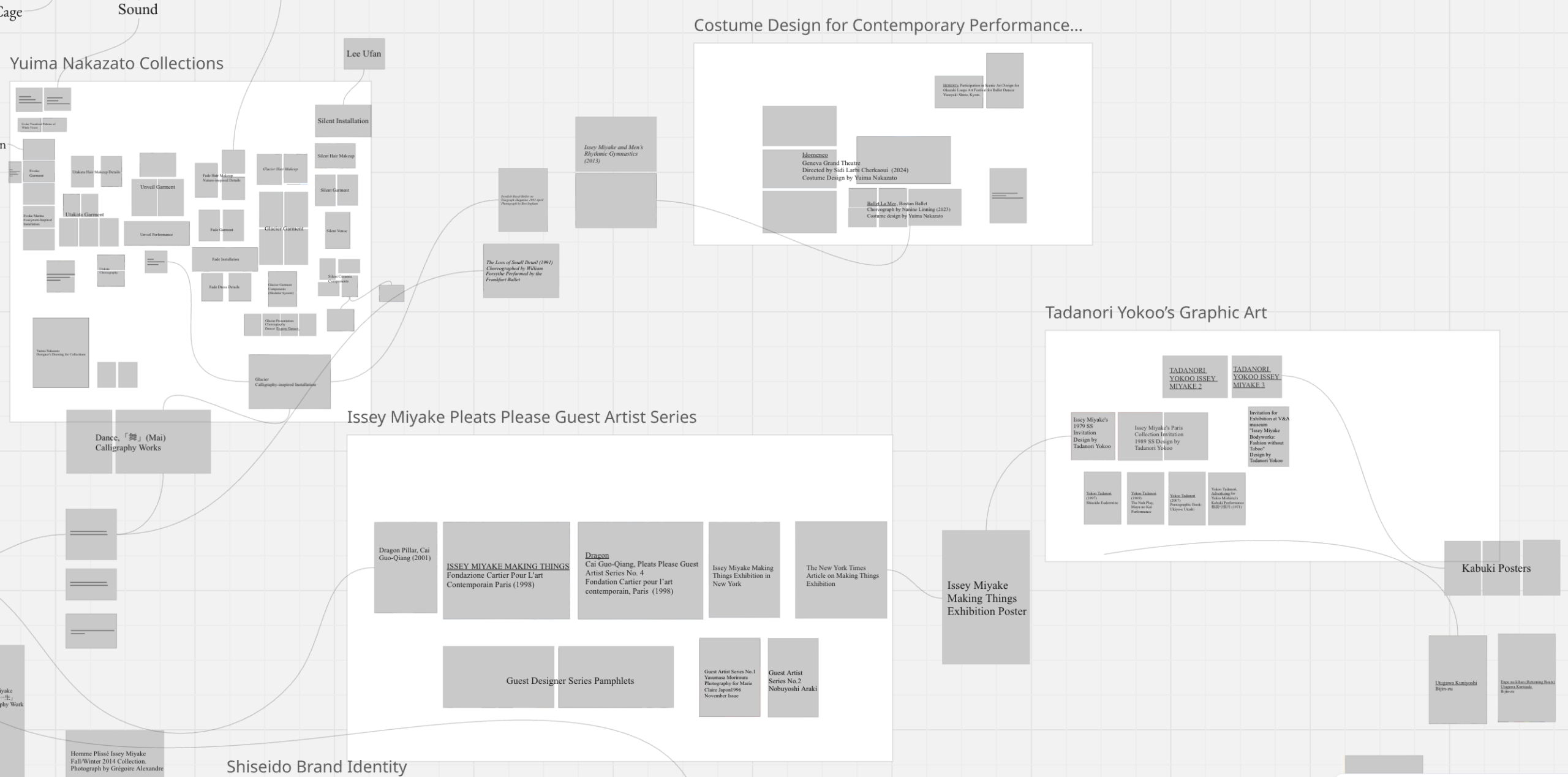
Appendix A: Visual Map A
Appendix B: Visual Map B
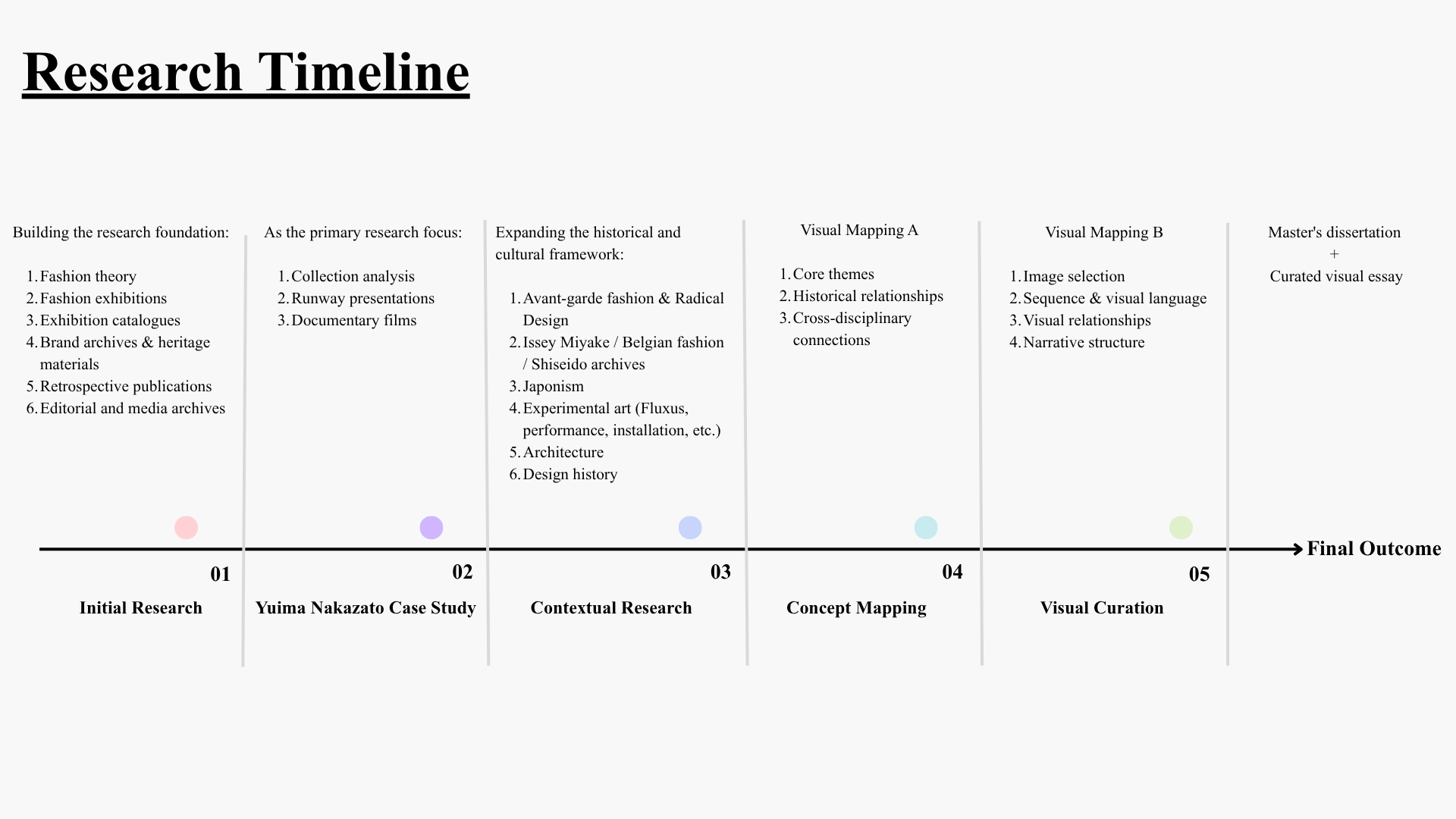
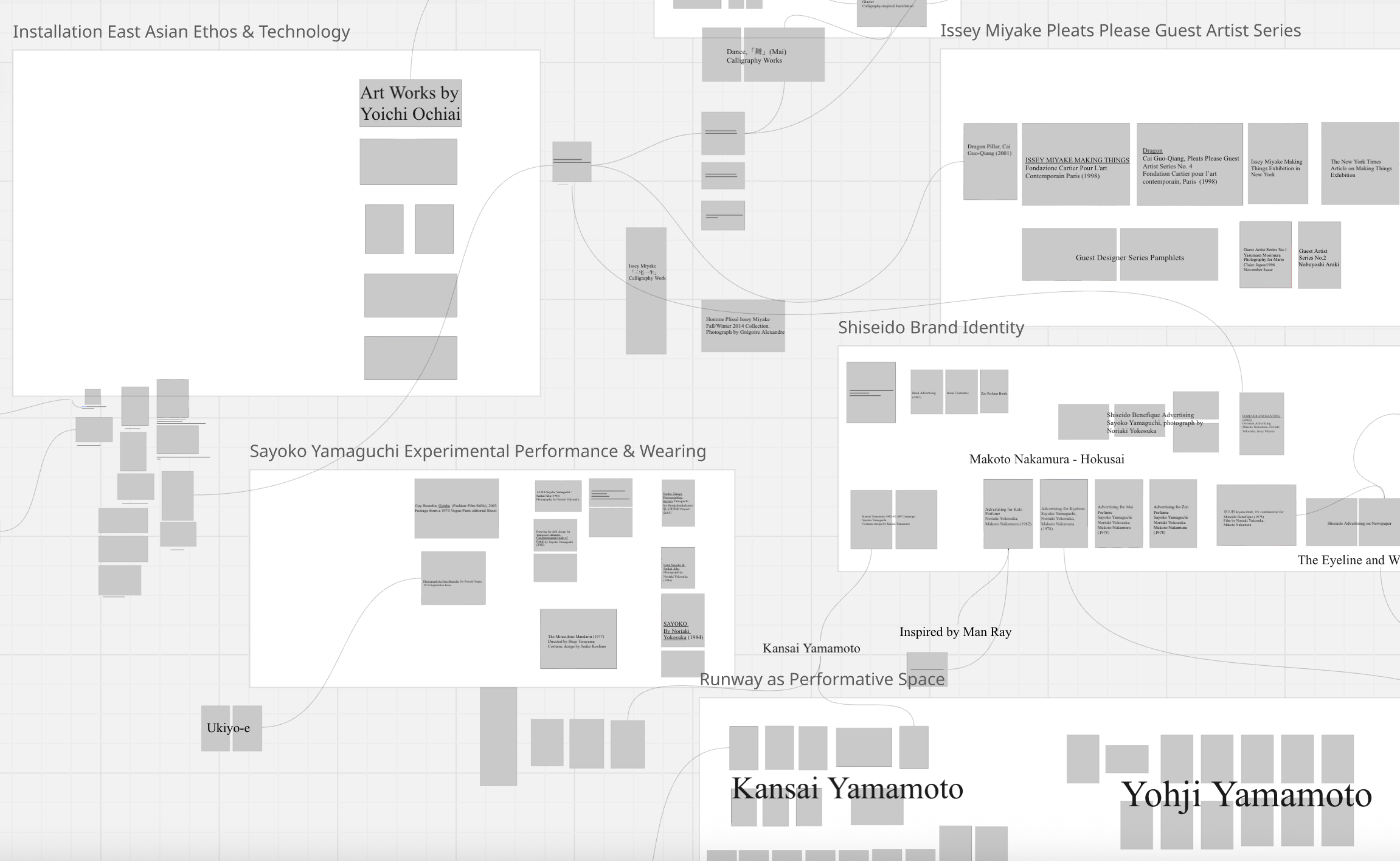
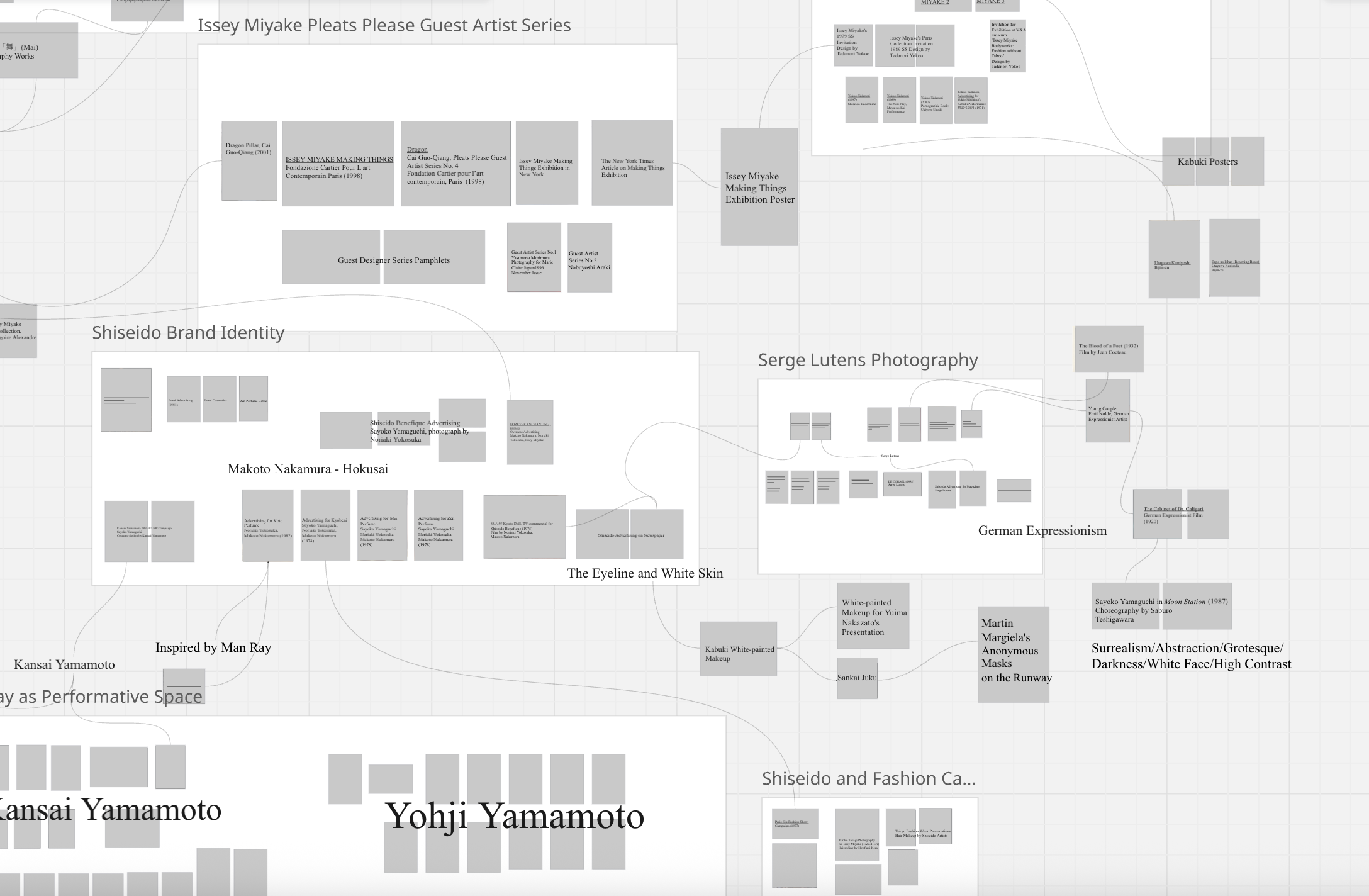
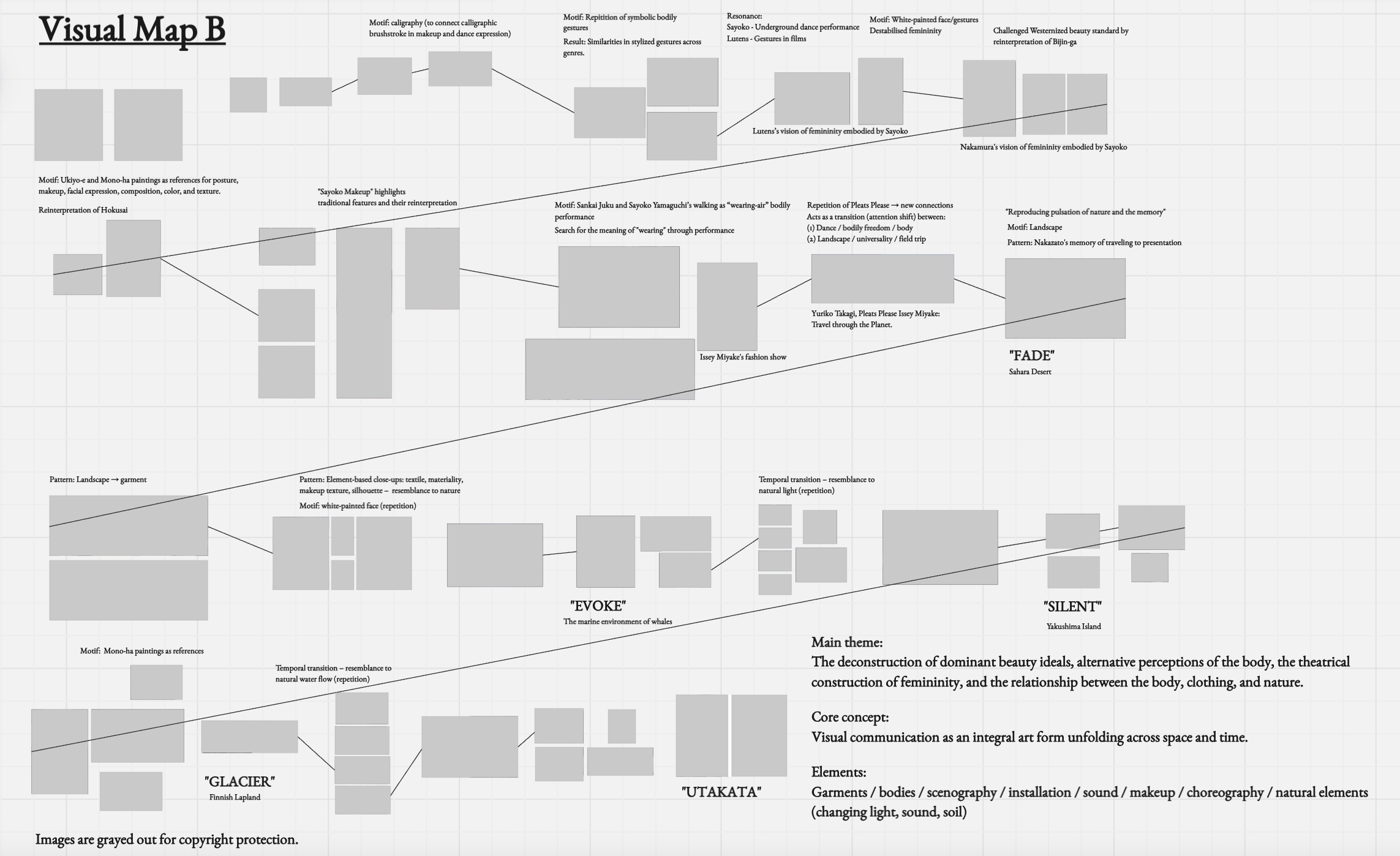
The visual essay was developed as the visual component of the master’s research project through archival research, conceptual mapping, and image curation.
This visual essay explores fashion as a form of visual culture beyond the garment itself, examining the relationship between clothing, body, image, space, sound, and performance. Through archival research and image curation, the project proposes alternative ways of experiencing fashion as an accessible cultural expression.
Due to copyright restrictions on reproduced archival and editorial images, the complete visual essay is not publicly available on this website.
The full visual essay is available upon request for academic or professional purposes.
本ビジュアルエッセイは、修士研究の一部として、アーカイブリサーチ、コンセプト設計、イメージキュレーションのもと制作しました。
本作では、ファッションを衣服、身体、写真、空間、音、自然、ジェスチャー、パフォーマンスが交差する総合的なビジュアルアートとして捉え、文章では伝えれきれない関係性を可視化することを目的としています。アーカイブ資料の分析とイメージキュレーションを通じて、ファッションの背景知識の有無にかかわらず、より多くの人がファッションを文化・アート的表現として体験できる新たな見方として提案します。
なお、本ビジュアルエッセイにはアーカイブ資料やエディトリアル写真など著作権保護の対象となる画像を含むため、本ウェブサイトでは公開しておりません。閲覧をご希望の場合は、お問い合わせいただけましたら個別にご案内いたします。